





 English
 USA
USA
 西班牙语
西班牙语
 俄罗斯
俄罗斯
 葡萄牙
葡萄牙
 印尼
印尼
 巴基斯坦
巴基斯坦
 尼日利亚
尼日利亚
 孟加拉
孟加拉
 墨西哥
墨西哥
 越南
越南
 日本
日本
 韩国
韩国
 沙特阿拉伯
沙特阿拉伯

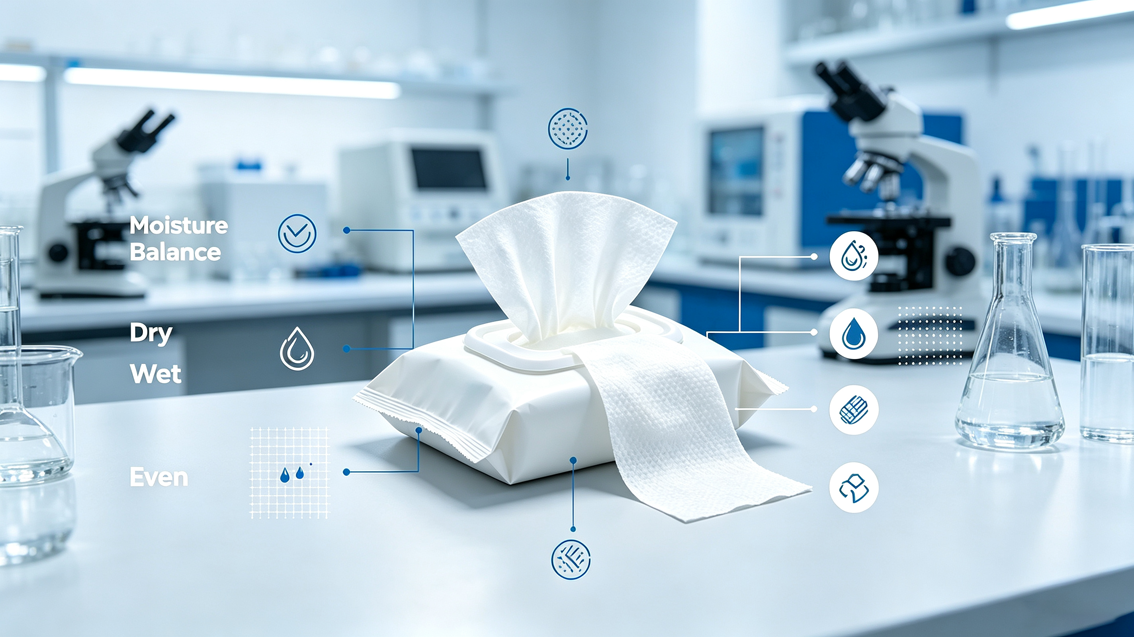
In the global wet wipes industry, manufacturers often focus on nonwoven fabric selection, packaging design, and production efficiency. However, one of the most common quality complaints from consumers is directly related to the wet wipes liquid formulation:
The wipes are too dry and do not provide enough cleaning performance.
The wipes contain excessive liquid and feel uncomfortable during use.
The lotion is unevenly distributed, causing some wipes to be wet while others remain dry.
These problems not only affect user experience but also increase production losses, customer complaints, and brand risks.
For wet wipes manufacturers, achieving the right moisture balance requires precise control of formulation design, raw materials, liquid loading ratio, and production process.
1. Why Do Wet Wipes Become Too Dry?
1.1 Low Liquid Add-On Ratio
The most direct reason for dry wipes is insufficient lotion absorption.
The liquid add-on ratio (also called lotion loading ratio) determines how much wipes lotion is absorbed by the nonwoven fabric.
If the ratio is too low:
The wipe feels dry during use.
Cleaning performance decreases.
Functional ingredients cannot work effectively.
Consumers may perceive the product as low quality.
However, simply increasing liquid content is not always the solution. The formulation must match the absorbency characteristics of the substrate.
Different nonwoven materials, such as:
spunlace
airlaid
viscose blend
polyester blend
have different liquid absorption capacities.
A professional wipes liquid formulation supplier should adjust the lotion system according to fabric structure.
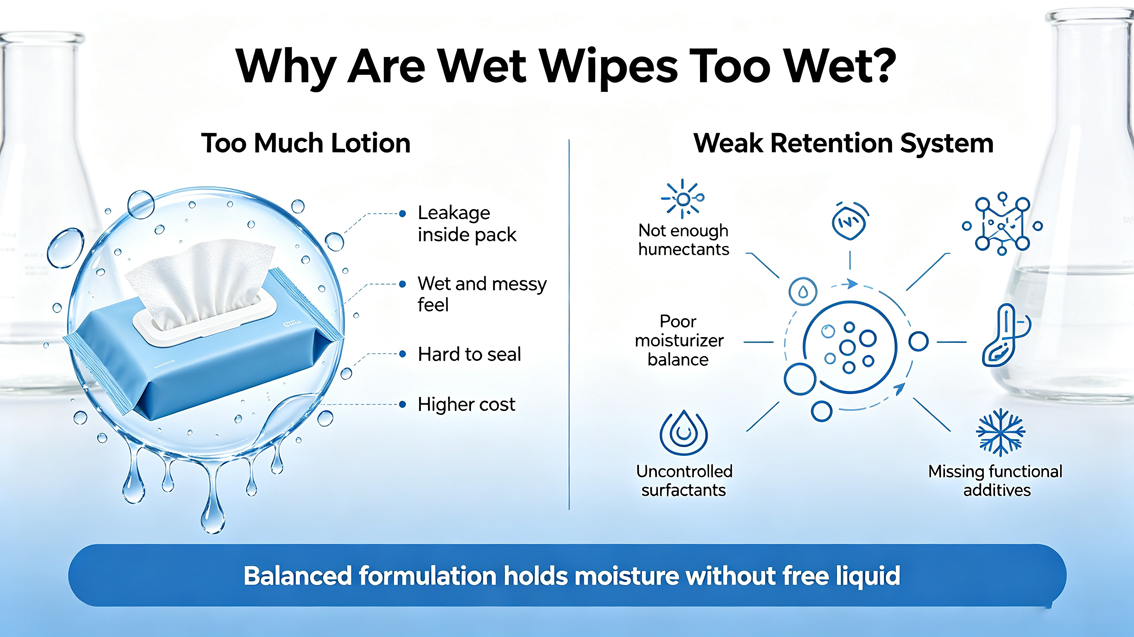
2. Why Are Wet Wipes Too Wet?
2.1 Excessive Lotion Addition
Adding too much liquid can create several problems:
Liquid leakage inside packaging.
Poor user experience.
Difficulty in sealing and transportation.
Increased formulation cost.
For example, baby wipes require a soft and moisturizing feeling, while disinfecting wipes require controlled liquid release to maintain active ingredient concentration.
The optimal lotion level depends on:
Product category
Fabric type
Packaging format
Target market regulations
2.2 Poor Water Retention System
A good wet wipes formulation is not only about adding more water.
The formula needs a balanced system including:
humectants
moisturizers
surfactants
preservatives
functional additives
Ingredients such as glycerin, propylene glycol, and other moisturizing agents help control water migration and improve skin feel.
An optimized wipes lotion can maintain moisture without creating excessive free liquid.
3. Why Does Liquid Distribution Become Uneven?
Uneven wetness is one of the most common problems during wet wipes production.
Typical symptoms include:
The first few sheets are too wet.
Middle sheets have balanced moisture.
Bottom sheets are too dry.
This problem usually comes from several factors.
3.1 Poor Formula Penetration Ability
The viscosity and surface tension of wipes lotion directly influence penetration speed.
If the lotion penetrates too slowly:
Liquid stays on the surface.
Fabric absorption becomes uneven.
If penetration is too fast:
Liquid quickly moves to the bottom layers.
Upper sheets become insufficiently moisturized.
3.2 Improper Preservative and Additive System
Some functional ingredients may affect:
viscosity
stability
compatibility
liquid migration
For example, excessive thickening agents can reduce absorption speed, while an unsuitable surfactant system may cause poor wetting performance.
Therefore, wipes liquid formulation needs compatibility testing before mass production.
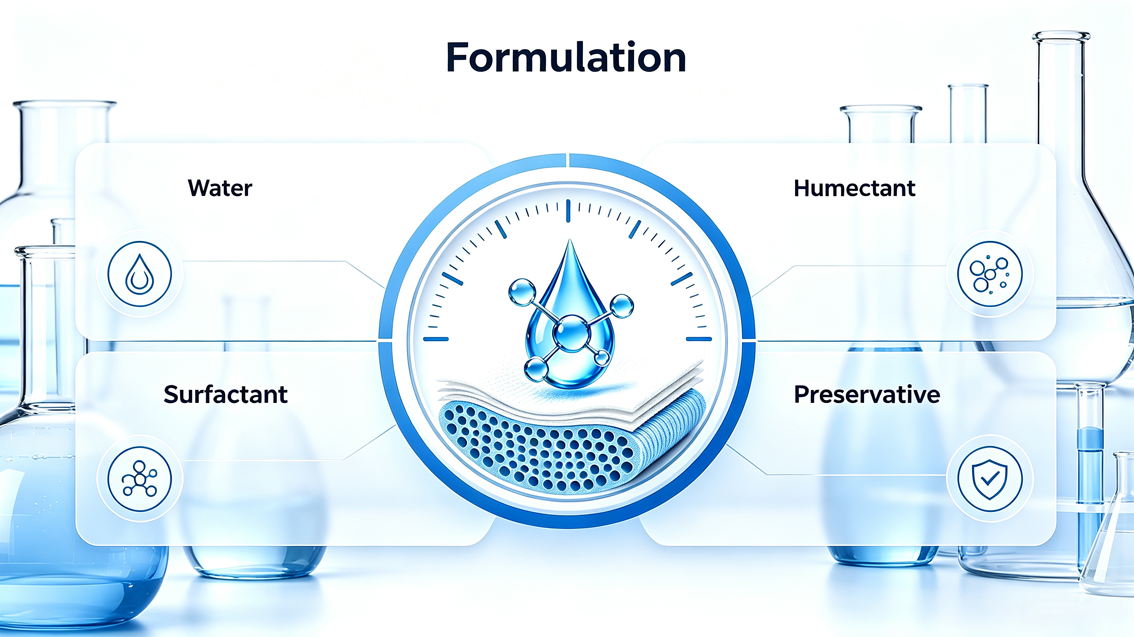
4. Key Factors to Optimize Wet Wipes Liquid Formulation
4.1 Control the Water Content
Water is the largest component in most wet wipes products.
However, higher water content does not always mean better performance.
A professional formulation should balance:
moisture level
evaporation resistance
preservation performance
skin compatibility
4.2 Optimize Humectant System
Humectants help maintain moisture and improve softness.
Common ingredients include:
Glycerin
Propylene Glycol
Sorbitol
Betaine
The dosage needs careful adjustment.
Too little:
wipes dry faster.
Too much:
sticky feeling may appear.
4.3 Select the Right Surfactant System
For cleaning wipes, surfactants improve:
oil removal
dirt removal
spreading ability
However, excessive surfactants may cause:
irritation risk
poor skin feeling
foam problems
4.4 Build a Stable Preservation System
Because wet wipes contain a high percentage of water, microbial control is critical.
An effective preservative system should consider:
product category
target country regulations
pH value
ingredient compatibility
A stable preservation system helps maintain product safety throughout shelf life.
5. Production Process Also Affects Moisture Uniformity
Even with a good wipes liquid formulation, production parameters can influence final quality.
Important factors include:
Liquid Application Method
Different methods such as:
spraying
dipping
continuous impregnation
can create different moisture distribution results.
Folding and Packaging Process
Incorrect folding pressure or packaging conditions may cause:
liquid accumulation
uneven migration
leakage problems
Storage Conditions
Temperature fluctuations during storage and transportation may accelerate liquid migration.
Manufacturers should conduct stability testing under different conditions.
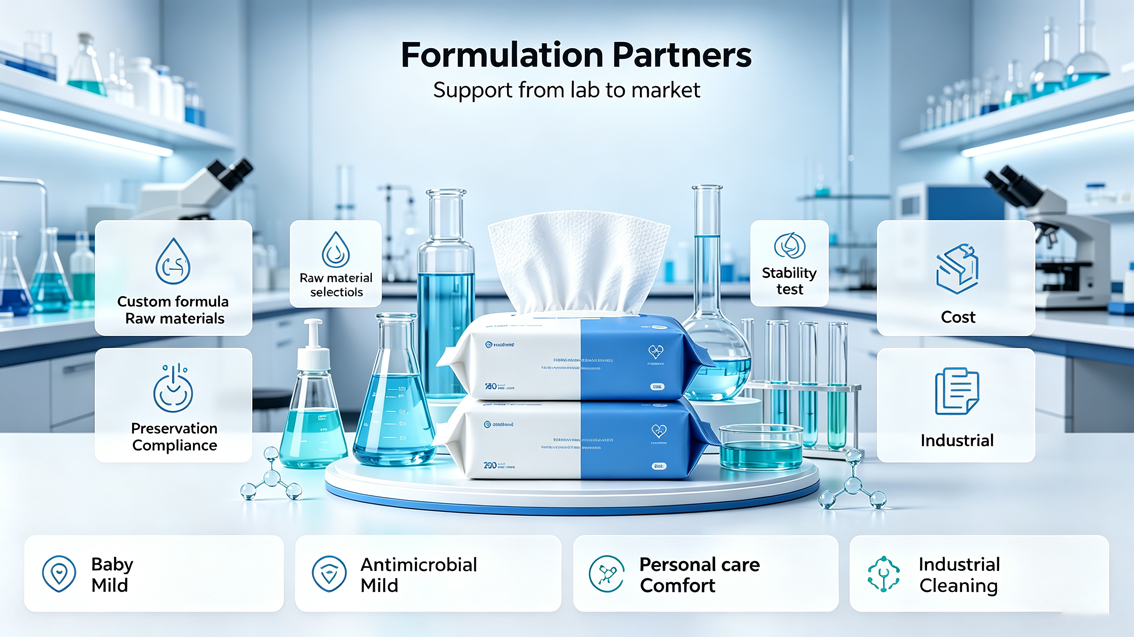
6. How Professional Wet Wipes Formulation Suppliers Help Manufacturers
Developing a successful wet wipes product requires more than a basic formula.
A professional wipes liquid formulation partner can help manufacturers with:
Customized lotion development
Raw material selection
Preservative system design
Stability testing
Regulatory compliance support
Cost optimization
Different markets require different solutions:
Baby wipes focus on mildness and skin safety.
Disinfecting wipes focus on antimicrobial performance.
Personal care wipes focus on comfort and sensory experience.
Industrial wipes focus on cleaning efficiency.
Conclusion: Moisture Balance Determines Wet Wipes Quality
The problems of "too dry", "too wet", and "uneven liquid distribution" are not caused by a single factor.
They are the result of the interaction between:
wet wipes liquid formulation
nonwoven fabric characteristics
lotion loading ratio
production process
packaging design
For wet wipes manufacturers, optimizing the lotion system is one of the most effective ways to improve product quality, reduce complaints, and create competitive products in the global market.
A scientifically designed wipes liquid formulation can help manufacturers achieve the ideal balance between moisture, performance, safety, and cost.
