





 English
 USA
 西班牙语
 俄罗斯
 葡萄牙
 印尼
 巴基斯坦
 尼日利亚
 孟加拉
 墨西哥
 越南
 日本
 韩国
 沙特阿拉伯

Are you planning to enter the wet wipes manufacturing industry but don't know where to start?
Wet wipes are widely used in baby care, personal hygiene, skincare, household cleaning, pet care, and industrial applications. For entrepreneurs and businesses looking to enter the manufacturing sector, wet wipes can offer opportunities in both domestic and international markets.
However, starting a wet wipes manufacturing business requires more than purchasing a production machine. You need to understand your target market, choose suitable products, source reliable raw materials, develop the right wet wipes liquid formulation, establish quality control procedures, and build a customer acquisition strategy.
This guide explains the essential steps to help beginners plan their wet wipes manufacturing business more effectively.
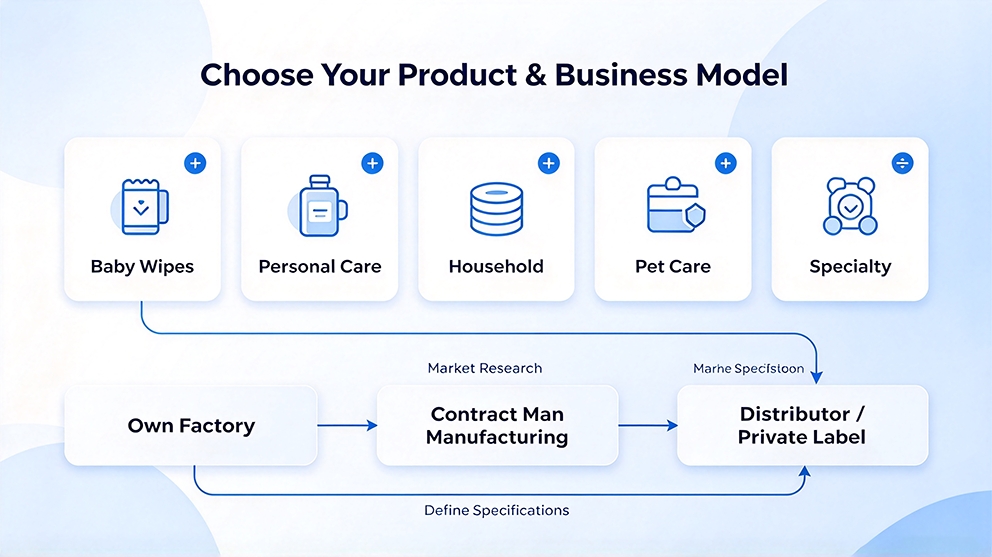
1. Choose Your Wet Wipes Product Category
The first step is deciding what type of wet wipes you want to manufacture. Different products require different materials, formulations, packaging, and production equipment.
Common categories include:
Baby wipes: Designed for baby care, with particular attention to skin-contact suitability, softness, microbiological quality, and packaging.
Personal care wipes: Including facial cleansing wipes, makeup remover wipes, and personal hygiene wipes.
Household cleaning wipes: Used for kitchens, bathrooms, floors, furniture, and other surfaces.
Pet wipes: Designed for paw cleaning, coat care, and other pet hygiene applications.
Specialty wipes: Including leather cleaning wipes, shoe cleaning wipes, automotive wipes, and industrial cleaning wipes.
For beginners, focusing on one or two product categories is usually more manageable than launching a large product range immediately.
Before making an investment, research your target customers, competing products, market prices, packaging preferences, and quality requirements.
2. Choose Your Business Model
There is more than one way to enter the wet wipes industry.
Build your own factory
You purchase production equipment, establish a manufacturing facility, source raw materials, and produce finished products.
This model offers greater control over production but requires investment in equipment, facilities, labor, quality management, and working capital.
Start with contract manufacturing
You work with an established wet wipes manufacturer to produce products under your own brand or for your customers.
This approach can help you test market demand before investing in your own production line.
Become a distributor or private-label supplier
You purchase finished wet wipes from manufacturers and sell them to retailers, distributors, or business customers. This model focuses more on sales, branding, and supply chain management than factory operations.
Beginner's tip: Choose a business model based on your budget, experience, customer resources, and realistic market demand.
3. Select the Right Wet Wipes Production Equipment
If you decide to build your own factory, equipment selection is one of your most important decisions.
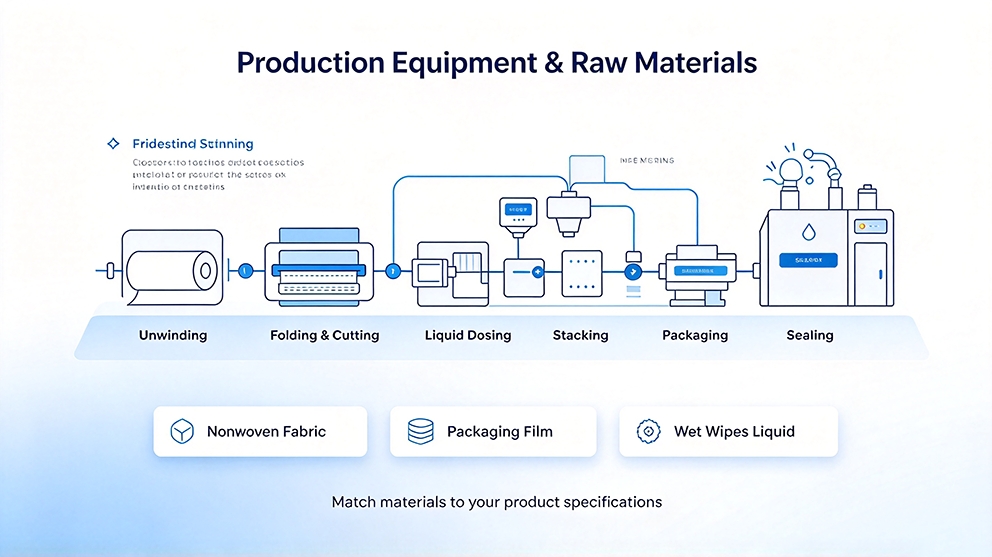
A typical wet wipes production line may include:
Nonwoven fabric unwinding and feeding systems.
Folding and cutting equipment.
Liquid dosing systems.
Wipe stacking mechanisms.
Automatic or semi-automatic packaging machines.
Sealing, coding, and inspection equipment.
The specific configuration depends on your product dimensions, number of wipes per pack, packaging format, and production capacity.
When comparing machines, consider more than the advertised production speed. Evaluate product flexibility, changeover time, dosing accuracy, labor requirements, maintenance, spare parts, and after-sales service.
Avoid purchasing a high-capacity machine before confirming that you have enough customer demand to use it efficiently.
4. Choose Suitable Raw Materials
The quality of your wet wipes depends heavily on the materials used in production.
Nonwoven fabric
The substrate affects softness, absorbency, liquid retention, strength, and the overall user experience. Common options include spunlace nonwovens, polyester-viscose blends, and selected cellulose-based materials.
Choose a substrate that meets your product specifications and works well with your production equipment and liquid formulation.
Packaging materials
Packaging protects the wipes during storage and transportation while helping maintain moisture and product integrity.
Consider packaging compatibility, seal performance, dispensing convenience, appearance, and cost.
Wet wipes liquid ingredients
The liquid formulation is another essential part of the product. Its composition should be determined by the intended application rather than selected solely on price.
Reliable suppliers, consistent material specifications, and appropriate incoming quality checks help reduce production problems.
5. Develop the Right Wet Wipes Liquid Formulation
A suitable wet wipes liquid formulation can influence cleansing performance, skin feel, fragrance, residue, stability, and microbiological quality.
Different products require different formulation strategies.
For example:
Baby wipes may prioritize gentle cleansing and suitable skin-contact characteristics.
Facial wipes may require effective makeup and sebum removal.
Household cleaning wipes may need stronger cleaning performance and low-residue properties.
Leather cleaning wipes may require careful evaluation of surface compatibility.
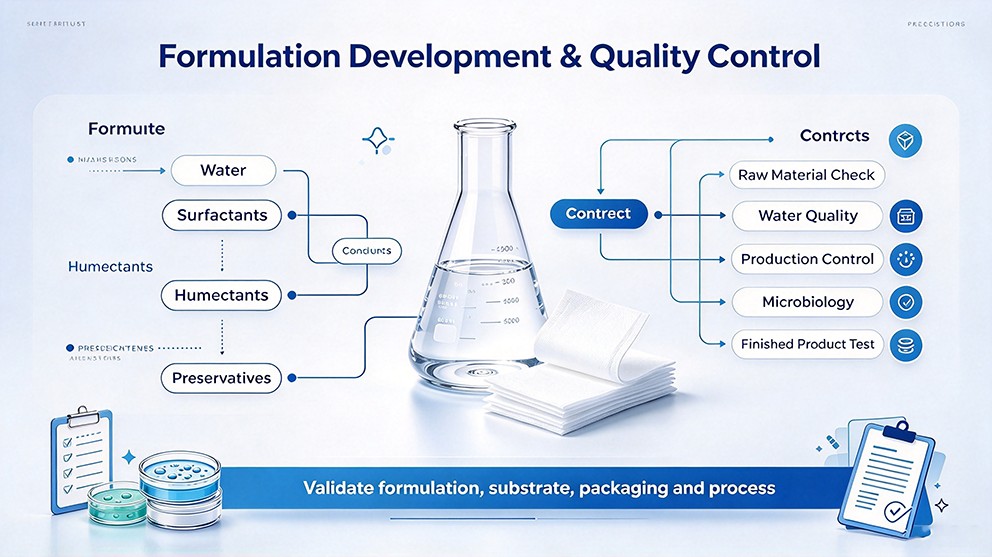
Depending on the product, a formulation may contain water, surfactants, humectants, preservatives, pH-adjusting ingredients, fragrance, or other functional additives.
Not every product needs every ingredient. The goal is to select the simplest formulation that meets the product's performance and safety requirements.
Why should beginners work with a professional formulation supplier?
Developing a reliable wet wipes liquid requires more than mixing ingredients. Manufacturers need to consider ingredient compatibility, substrate performance, packaging interactions, stability, and microbiological control.
For a new manufacturer without an in-house formulation laboratory, working with an experienced wet wipes liquid supplier can help simplify product development and identify technical issues earlier.
The formulation should be evaluated with the actual substrate and packaging intended for production.
6. Establish Quality Control and Regulatory Compliance
Quality control should be built into the manufacturing process from the beginning.
Important areas include:
Raw material inspection: Check incoming materials against approved specifications.
Water quality: Establish suitable water specifications, monitoring, and sanitation procedures.
Production control: Monitor wipe dimensions, sheet count, liquid loading, package weight, and sealing.
Microbiological control: Establish appropriate controls and testing based on the product's risk profile.
Finished-product testing: Evaluate relevant physical, chemical, microbiological, stability, and performance characteristics.
Traceability: Maintain batch records and procedures for handling complaints and product recalls.
Regulatory requirements depend on the product type and target market. Baby wipes, cosmetic wipes, household cleaning wipes, and disinfecting wipes may be subject to different requirements.
Before launching a product, confirm the applicable ingredient, labeling, testing, documentation, and marketing-claim requirements. Claims such as "antibacterial," "disinfecting," or "sterile" should not be used without confirming the relevant requirements and supporting evidence.
7. Calculate Your Manufacturing Costs
Before setting wholesale prices, calculate the total cost of producing each pack.
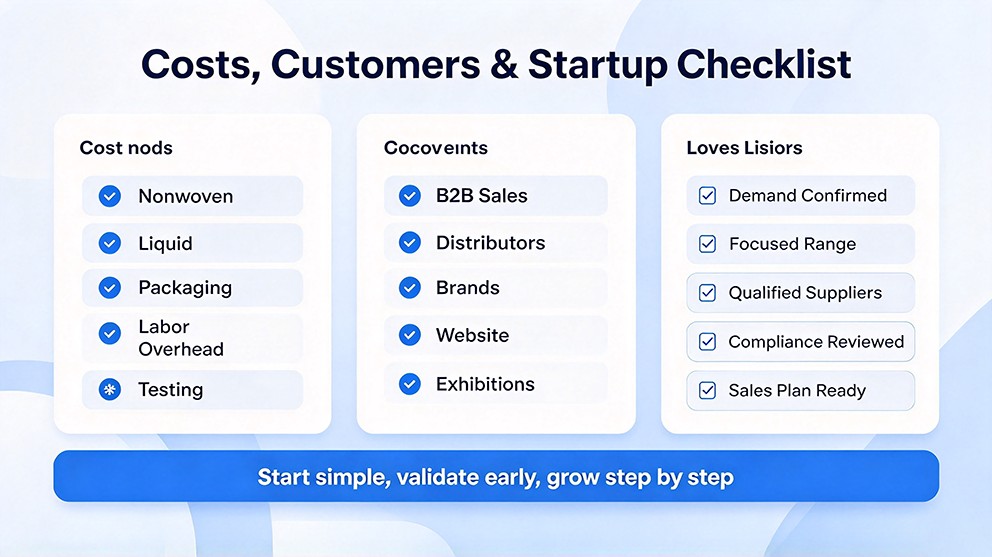
Your cost model should include:
Nonwoven fabric.
Wet wipes liquid ingredients.
Packaging film, labels, and cartons.
Labor and utilities.
Equipment depreciation and maintenance.
Quality testing and production waste.
Factory overhead.
Warehousing and logistics.
Working capital is also important. You may need to pay for materials and production before receiving payment from customers.
Do not focus only on the cheapest raw materials or equipment. Poor material quality, production waste, and customer complaints can increase your total operating costs.
A realistic cost model helps you set competitive prices while maintaining a sustainable profit margin.
8. How to Find Customers for Your Wet Wipes Business
Production capability alone does not guarantee business success. You also need a clear customer acquisition strategy.
Potential customers include:
Retailers and wholesalers.
Importers and distributors.
Baby care and personal care brands.
Household cleaning brands.
Private-label businesses.
Industrial supply companies.
You can reach these customers through direct B2B sales, industry exhibitions, distributor partnerships, online marketplaces, and your company website.
Build a professional B2B website
A website should clearly explain your product categories, manufacturing capabilities, packaging options, quality controls, and customization services.
SEO articles can help attract buyers who are researching wet wipes manufacturing, production equipment, raw materials, and liquid formulations.
Useful article topics include:
How to Choose a Wet Wipes Production Machine.
Essential Raw Materials for Wet Wipes Manufacturing.
How to Develop a Baby Wipes Liquid Formulation.
How to Calculate Wet Wipes Manufacturing Costs.
Educational content helps potential customers understand your expertise before contacting your sales team.
9. Common Mistakes Beginners Should Avoid
New manufacturers should pay attention to several common mistakes:
Buying equipment before confirming demand. Research customers and define your product specifications before making a major investment.
Manufacturing too many product types. Start with a focused product range and expand as demand grows.
Choosing suppliers based only on price. Evaluate quality consistency, documentation, technical support, and supply reliability.
Ignoring liquid formulation development. A suitable formulation is essential for product performance and compatibility with the substrate and packaging.
Underestimating working capital. Include inventory, labor, overhead, and customer payment terms in your financial plan.
Overlooking compliance requirements. Confirm the requirements of your target markets before finalizing your product and marketing claims.
Avoiding these mistakes can help you reduce unnecessary costs and build a more stable manufacturing operation.
10. A Practical Checklist Before You Start
Before investing in a wet wipes manufacturing business, make sure you have addressed the following points.
Identified your target market and customer groups.
Selected your initial wet wipes product categories.
Compared factory ownership, contract manufacturing, and distribution.
Estimated equipment costs and working capital.
Evaluated nonwoven fabric and packaging suppliers.
Identified a suitable wet wipes liquid formulation strategy.
Established quality control and testing requirements.
Reviewed the regulatory requirements of your target markets.
Prepared a sales and marketing plan.
You do not need to solve every challenge at once, but you should understand the major requirements before committing substantial capital.
Conclusion
Starting a wet wipes manufacturing business requires careful planning across product development, equipment, raw materials, quality management, regulatory compliance, and sales.
The most effective approach is to begin with a clearly defined market, choose a manageable product range, and make investment decisions based on actual customer requirements.
Remember that a successful wet wipes business depends on more than production capacity. Consistent product quality, suitable liquid formulations, reliable suppliers, and a strong customer base are equally important.
Need a Wet Wipes Liquid Formulation Supplier?
At WipesLiquid, we supply wet wipes liquid formulations for wet wipes manufacturers worldwide, supporting different applications including baby care, personal care, household cleaning, and specialty wipes.
If you are preparing to enter the wet wipes manufacturing industry or develop a new wet wipes product, contact our team to discuss your product specifications and explore suitable formulation options.
Start with the right product, build a reliable supply chain, and grow your wet wipes business step by step.
